The issue of moving immersively within virtual environments and landscapes, without cracking your head open on a physical wall has always been at the forefront of VR work. Fundamentally, there has to be a way to navigate without walking into walls.
Sections
Six degrees of freedom represent total movement. X, Y, and Z axis are the normal three. Pitch, roll, and yaw join them for every possible movement.

Game Law: Everybody Conga?
Remember those old movies with the long conga line in them? Well, imagine that the line is a line of gamers. But some of the gamers can't dance. So, no conga for them. They're just watching their friends have fun while dealing with a frustrated desire to dance themselves. That is what it is like for an estimated 20-25% of the population over the age of 17. This is because these potential gamers have one or more physical or cognitive disabilities. Games and VR worlds do not provide for them, so they cannot participate.
The Wii: Truly a Wanda for Everyone?
 The Nintendo Wii has been out for almost half a year at time of writing. The Wii-mote 3D pointer control coming straight with the system was a massive gamble for the company, and, if it had not taken off, it would have buried the hopes of the VR community, that full immersion systems have any chance of being mainstream.
Tongue Drive Technology
 Tongue drive sounds at first like a strange sexual fetish. That may well be true, but it is also a disability-overcoming interface that has been developed over the past year by the Georgia Institute of Technology.
Tracking Your Fingers with the Wiimote
 By using an LED array made out of cheap to buy LEDs placed in a grid with a hole in the middle for the Wii-mote to point through, some software, and some foil stickers on the fingers, a home-use, very basic multi-point interaction system is born.
Originally created in 2004, CirculaFloor is a continually improved system of four robotic floor tiles, designed to allow an 'infinite treadmill' in VR. Wherever you put a foot, the four tiles work as swarm robots to ensure there's a tile under that foot when it lands.
In early 2008, the Max Planck Institute for Biological Cybernetics researchers developed an omnidirectional treadmill to facilitate unconstrained walking in all directions through large-scale virtual environments.
Expresso Fitness has unveiled a somewhat unique range of exercise bikes, designed to truly integrate a VR experience into the ride. Usually with an exercise bike, the VR element is an afterthought tacked on, or using an LCD screen. With these bikesthat is simply not the case. They log in to a unique MMO whilst you exercise.
VR Interfaces: Gyration Air Mouse
 Movea?s Gyration Air Mouse is essentially an updated wand, or 3D pointer. It is hopefully the first of a new breed that works just as well in 2D on the desk, as it does bneing waved about in 3D in the air.
Motus are moving in on the motion sensing capabilities of 3D pointers for home PCs. Inspired by the Nintendo Wii?s popularity, their Motus Darwin, a mainstream 3D pointer, takes a slightly different approach.
The MX Air is essentially a 6 DOF mouse. Bearing more than a passing similarity to a Wii-mote, the sleek black device is intended to be held in the hand like a remote control. An internal gyroscope and accelerometers detect its position and orientation in 3D space continually, reporting that information back to the computer system via 2.4ghz Wi-Fi.
Originally created in 1989, by Nintendo, the Power Glove is at once a symbol of mainstream VR, and a source of derision and ridicule. It is a humiliating failure, that lingers in the minds of many. Even 20 years later, many use the power glove and its ilk to mock the field of VR.
The powered shoes VR interface, due to be demonstrated at the 2006 SIGGRAPH conference, is a locomotive platform for virtual environments. The actuating motors the shoes employ actually work to cancel out the movement of the walker - they walk or run and the shoes motor to pull them back to the start position.
The Robot Tiles system was created by Hiroo Iwata, a professor working in the VR lab at the University of Tsukuba in Japan, and a familiar name for this site. It is essentially a clone of the CirculaFloor system, with updated and improved robotic swarm AI and motion control.
There are half a dozen different designs of the stealth mouse, in two distinct flavours. One flavour is seen as a mouse by default, and works with Windows/Linux/Mac standard mouse drivers. The other is not, and requires specialist drivers to work alongside a normal mouse.
Introducing the StringWalker. The StringWalker is basically a VR locomotion sensor, to try to allow unimnpeded natural movement in virtual worlds - without bashing your nose on a physical wall. It uses strings and pulliess for its' unique approach.
One of the great issues with immersive VR has always been allowing natural movement in enclosed spaces. The VirtuSphere looks a lot like a giant mouse ball, or hamster wheel. However, it is perfect for the task at hand - complete freedom in all six degrees.
The Trazer by Cybex Incorporated. Billed as a virtual reality exercise machine, this $6,495 USD (?3,300) machine tracks an infrared belt worn by the exerciser, and uses changes in the position of that, and senses of increase or decrease in heat rate, to determine how much they are exercising.
The Vocal Joystick is a hardware interface for those with severe disabilities such as motor impairments. Provided they can make sounds with their larynx, even if they are not words, the user can navigate a virtual environment, or web page.
The Wanda was the first of the wands/3D pointers, which are essentially mice working in three dimensions, with six degrees of movement. Still around today, Wanda is often the input device of choice for CAVE style VR interfaces.
The Nintendo Wii - formerly the Nintendo Revolution, was formally announced at an E3 2006 press conference. The display screen lit up to a Mario game, with Mario running around, and picking up crates to throw at enemies - and the crate followed the same path onscreen.
The Wii Balance Board is literally as it sounds. It is a small, white board you stand upon, with internal pressure pads in formation, to detect any slight changes in weight as your posture changes on top of it.
The new Wii Motion plus is designed to provide high fidelity motion detection to the Wii-mote. It plugs into the port that the nunchuk controller ordinarily plugs into, effectively lengthening the remote. Together Wii-mote and motion plus function as one object, with the plus basically being a gyroscope set for fine motion detection.
Created in 2007, the Wii Power Glove was a homage to the original Power Glove, made utilising a haptic glove and a wii remote control. In essence, a power glove made using the direct descendant of the same.
Eye tracing, head tracking, devices that monitor the movement of the attention, work out where you would like to focus, and respond.
In a paradigm where overcoming physical constraints is key, a webcam may seem a very odd VR interface device. However, what lays true for one section of individuals, dows not always lay true for another. The PS2?s EyeToy has done much in the cause of using physical body form as an input device.
VR Interfaces: Tongue Drive
 An assistive technology developed by engineers at the Georgia Institute of Technology, tongue drive is an attempt to bypass the need for brain computer interfaces in motion control for severe disabilities.
Announced just one day after the Nintendo Wii itself, at E3 2006?s second day, the Nintendi Wii light-gun attachment connects directly to the back of the Nintendo Wii-mote immersion controller.
Back To Top
Motion capture technologies are perhaps the most closely realised technology for putting body language and body expression into virtual environments.
Combining MoCap and Gesture Recognition
 MoCap - Motion Capture - for all its impressive abilities, has definite limitations in terms of sensory fidelity, the expense and bulk of the rig. Gesture control is cheap and captures every little movement, but easily overwhelmed. Is a hybrid system possible?
Interfaces > DesIRe
DesIRe is a gesture recognition system designed to aid virtual reality systems interfaces. It works via a variant on MoCap: The user dons a pair of datagloves embedded with illuminated LEDs.
Mazan: Flash of the Blade
 An early commercial electromagnetic tracker system that surfaced in of all places, the arcade machines of 2002.
MoCap for Movement Analysis
 Promising work by QuinteQ on real-time motion capture without excessive hardware, holds promise for MoCap use in public VR.
Real-Time Feedback System for Skiers Opens Possibilities
 The vLink Computer System approach to skiing is rather novel. It's a data collection sensor set that clips to the front of a pair of skis, and in real-time, monitor in real-time forward speed and lateral displacement data of the skis as the skier proceeds down a mountain.
Back To Top
Understanding the Science of Running
 Running is not as simple a process as it seems at first glance. The physics of this type of movement is very different to the physics of walking, and as a result the leg and body movements are radically different. If we wish to recreate realistic running in either embodied robotic form, or via sequences for VR, then we need to understand this process intimately.
These intelligent shoe sensors are spread out over the surface of the shoe. Two at the back, two at the front. Evenly spread like this, the pressure sensors detect the precise angling and weight distribution of the foot with every step.
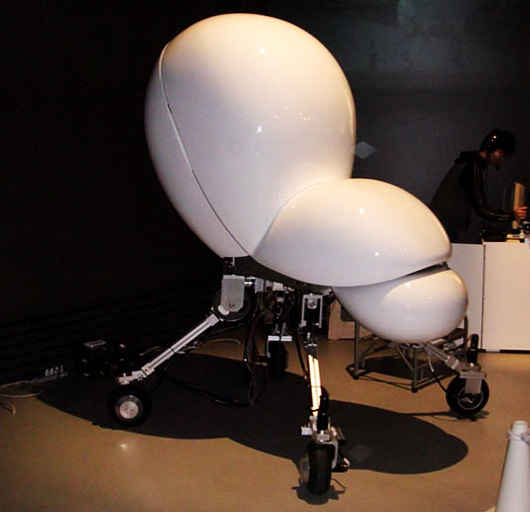
The Media Vehicle, is a serious take on VR interfacing, however it is not a serious commercial device. The unit is, for lack of a better phrase, an ?art tool?. It exists to showcase what is currently possible in 2009, not as a device which expects a practical market.
Where am I? Using Feature Cues for Navigation
 The brain is built to handle such a 3D world, and employs a number of tricks to counter disorientation. These are tricks we can utilise in 3D spatial simulations, to help minimise disorientation there; but first we have to understand what the brain's tricks are, and how they operate.
Back To TopLocomotive Therapy Interfaces (2)
Created as part of IEEE's Presidents' Change the World Competition 2009, the Augmented Walking Tutor is an augmented reality tile floor, similar in most respects to other such floors, but which is programmed to help disabled individuals either train or retrain for a healthy walking gait.
iSense is a sensory enhancement technology, designed to augment the brain's biofeedback from the muscles, and determine the extent of muscle fatigue before actual damage occurs.
|